OnlyFans Chatter Training (2026): How to Train a Team That Sells
OnlyFans chatter training, condensed: a new chatter needs a persona bible, a script library, and three supervised stages — shadow, co-pilot, solo — over roughly two weeks, then thirty days of KPI tracking (earnings per hour, PPV conversion, response time) before you decide to keep them. Agencies that skip the structure do not save two weeks; they spend three months paying a chatter who never learned to close.
This guide is the training program itself — week by week, with the scripts to write, the KPIs to track and the failure points we see most. It assumes you already have candidates; if not, start with our hiring and training SOP for sourcing and the interview funnel, then come back here to build the classroom.
Disclosure: some links in this article are affiliate links. If you sign up through them we may earn a commission at no extra cost to you — it never changes the prices we quote, the scores we give, or the criticism we publish.
What training has to produce (it is not politeness)
On professionally managed pages, DMs drive the overwhelming majority of revenue — our hiring guide puts it around 95%, with PPV unlocks the biggest slice. So the training goal is specific: a chatter who can hold a persona for hours, read which fan is warming up to a $50 unlock, and close without breaking the girlfriend experience. Customer-support instincts — fast, polite, neutral — are the most common starting point and the wrong finish line. You are training a sales floor.
That framing decides everything downstream: what goes in the persona bible, which scripts you drill, and why every KPI below is a revenue number before it is a service number.
Before day one: the three documents
Training without materials is vibes. Build these once per creator, before any trainee touches an inbox:
- The persona bible (GFE bible). One document per creator: backstory, tone, pet names she uses and never uses, hard boundaries, running jokes with regulars, current storylines. This is what lets five chatters feel like one girlfriend — the continuity fans actually pay to rebill for.
- The script library. Openers, re-engagement lines, PPV pricing ladders, custom-content negotiation, whale handling — written as frameworks with blanks, never as paste-ready lines (more below).
- The ops SOP. Shift handover template, escalation rules (refund threats, underage claims, doxxing attempts go to the manager immediately), and the security setup: chatters work inside your CRM or anti-detect browser profile and never hold the master password.
The week-by-week program
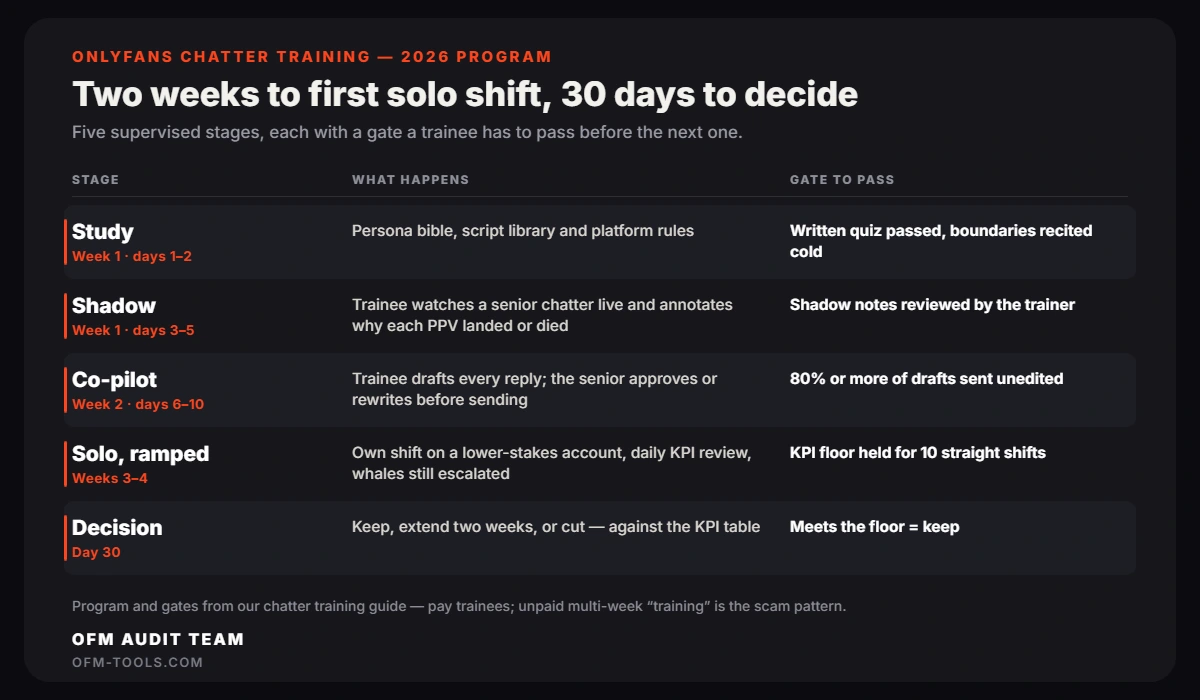
| Week | Stage | What happens | Gate to pass |
|---|---|---|---|
| Week 1, days 1–2 | Study | Persona bible + scripts + platform rules; written quiz on the persona | Quiz passed, boundaries recited cold |
| Week 1, days 3–5 | Shadow | Trainee watches a senior chatter live, annotates why each PPV landed or died | Shadow notes reviewed by trainer |
| Week 2, days 6–10 | Co-pilot | Trainee drafts every reply; senior approves or rewrites before sending | ≥80% of drafts sent unedited |
| Weeks 3–4 | Solo, ramped | Own shift on a lower-stakes account; daily KPI review; whales still escalated | KPI floor held for 10 straight shifts |
| Day 30 | Decision | Keep, extend two weeks, or cut — against the KPI table below | Meets floor = keep |
Two structural notes. First, the co-pilot stage is where training actually happens — the rewrite-and-explain loop teaches more in five days than two weeks of documents. Do not compress it. Second, pay people during training. A short paid trial is the industry-standard filter; multi-week unpaid “training” is the scam structure we warn candidates about in our chatter career guide — run one and the good applicants, who have read the same warnings, walk.
Scripts: frameworks, not lines
Fans smell copy-paste. The script library should teach shapes, and the drill is rewriting each shape in the persona’s voice. Five scripts cover most of the money:
- The new-sub opener. Goal: a reply, not a sale. Personal question tied to something visible on their profile beats “hey babe thanks for subbing” — the reply rate is the KPI.
- The PPV ladder. Tease → small unlock → escalate price with intimacy. Teach the price steps and the rule that matters: never send the next tier until the current one is opened. Unopened PPVs stacked in an inbox train the fan to ignore them.
- The re-engagement ping. For fans silent 5+ days: reference the last real conversation (from handover notes), never “miss you 🥺” in isolation. This script protects rebills, which compound harder than any single unlock.
- Whale handling. High spenders buy attention first and content second. The script is mostly patience: longer conversations, memory for details, and the discipline not to pitch on every message. A rushed whale is a lost whale.
- The custom negotiation. Scope, price anchor, delivery date, deposit — agreed in-chat before anything is promised to the creator. Teach chatters what the creator will not film; overselling a custom burns fan and creator at once.
Drill format that works: trainer plays the fan in a sandbox chat, throws one curveball per session — a price objection, a boundary push, a “are you even her?” — and the trainee has to stay in persona while closing. Twenty minutes a day through weeks 1–2.
The KPIs that decide who stays
Track per chatter, per shift, from the first solo day. The four that matter:
| KPI | Formula | Why it decides |
|---|---|---|
| EPH (earnings per hour) | Net revenue attributed to the chatter’s shift ÷ hours worked | The single ranking number; commission plans should key off it |
| PPV conversion | PPV unlocks ÷ PPV sent | Separates senders from sellers; low conversion + high volume = spam |
| Response time | Median minutes to first reply, peak hours | Cold inboxes churn subs; minutes, not hours, is the standard |
| Rebill / retention | % of the chatter’s regulars renewing | The GFE quality audit — bad chatting shows up here first |
Where to set the bars: against your own floor, not a forum number. Take your best current chatter’s trailing-30-day EPH and PPV conversion, set the trainee floor at roughly half of it for the day-30 gate, and expect convergence by day 60–90. Absolute benchmarks travel badly between niches and price points; internal ratios do not. For what the labor market itself pays against these numbers — $3–5/hour for entry offshore roles with 1–2% of net sales, rising to $1,500–4,000/month all-in for experienced closers, against the $3–7/hour plus 2–5% employers budget when they hire directly — see the pay breakdown in our chatter guide.
One warning on measurement: EPH only works if revenue attribution is per-shift and honest. If two chatters split a whale across a handover, credit the close where the handover notes show the work happened — chatters learn within a week whether your attribution can be gamed, and the good ones leave when it can.
The five training mistakes that cost real money
- Live whales on day one. A trainee learning on your top spender is a $300 custom negotiated at $80. Whales stay escalated until the day-30 gate is passed.
- Copy-paste script culture. Hand out paste-ready lines and you get a page where every fan gets the same three messages. Frameworks plus persona drills, always.
- No handover discipline. The 6 a.m. chatter who does not know last night’s whale is mid-negotiation resets the relationship. Handover notes are trained, reviewed and graded in week 2 — not assumed.
- AI ghostwriting the DMs. Letting trainees lean on chatbots to write replies is not a shortcut, it is an account risk: OnlyFans’ terms prohibit AI-written DMs, and the ban lands on the creator. AI for internal translation or drafting review is defensible; a human writes and sends every message.
- Training as a profit center. Charging recruits for “academy” courses or running unpaid multi-week trials filters for desperation, not talent — and marks you as exactly the operation our career guide tells candidates to flee.
Build, buy, or hybrid?
Training in-house makes sense from roughly $5k/month in page revenue — below that, the management overhead eats the margin. Above it, the math from our agency comparison is the anchor: outsourced inbox-only chatting bills 20–30% of revenue, so on a $20k page you are weighing a $4–6k monthly fee against the fully-loaded cost of two trained in-house chatters. If you would rather buy the capability than build it, vet providers against the red-flag list in our chatting agencies guide — and note that the good agencies run exactly the structure above: capped accounts per chatter, shift handovers, per-chatter KPIs the creator can see. That is what you are paying for. A hybrid also works: agency covers nights while you train your day team, then you insource shifts as trainees pass gates.
FAQ: training OnlyFans chatters
How long does it take to train an OnlyFans chatter?
Two weeks to first solo shift (study, shadow, co-pilot), thirty days to the keep-or-cut decision, and 60–90 days for a kept chatter to converge on your senior benchmarks. Faster usually means the co-pilot stage was skipped, and it shows up later in refunds and churn.
What should chatter training cost?
Mostly senior-chatter time: roughly two weeks of partial coverage from your best closer per trainee, plus the trainee’s paid training hours at entry rates. Budget it, and never invert it — charging trainees for training is the scam pattern, not a revenue line.
Can one training program cover multiple creators?
The mechanics transfer — scripts shapes, KPI definitions, escalation rules. The persona bible does not: every creator needs her own, and assigning a chatter to a new page means re-passing the persona quiz on that page, even for your best people.
Should chatters be trained on the CRM before the inbox?
Same week, but inbox skills first. Tools change; reading a fan does not. That said, agencies increasingly run CRMs with team permissions and analytics, so tool fluency belongs in week 1 — our hiring SOP covers the security half: profile isolation, no master passwords, NDAs signed before first login.