What Does an OnlyFans Manager Do? (2026): The Job, the Split, the Red Flags
What does an OnlyFans manager do? In one paragraph: a manager runs the business side of a creator’s account — content calendar, pricing strategy, fan-message operations, promotion and weekly revenue reporting — in exchange for a share of net revenue, typically 10–30%. The creator keeps making content; the manager makes the account behave like a business. What a manager does not do matters just as much: they do not own the account, they should never be the only person holding the login, and nobody serious guarantees earnings.
This page is the job description, written for both sides of the table. If you are a creator deciding whether to hire one, the responsibility breakdown and the vetting checklist are for you. If you want to be the manager, the career path with real pay data lives in our guide to becoming an OnlyFans manager — and building a whole company around the job is a different project, covered in how to start an OnlyFans management agency.
Disclosure: some links in this article are affiliate links. If you sign up through them we may earn a commission at no extra cost to you — it never changes the prices we quote, the scores we give, or the criticism we publish.
The day-to-day job: five workstreams
Strip away the Telegram-guru framing and management is five recurring workstreams. On a small account the manager does all five personally; at agency scale the same list becomes team supervision.
| Workstream | What it involves | Cadence |
|---|---|---|
| Fan-message operations | Chatting directly on small accounts; running chatter shifts, scripts and per-chatter KPIs on bigger ones | Daily — the biggest block, because DMs drive most account revenue |
| Content planning | Shoot lists, posting calendar, PPV drops, custom-content queue — planned so the creator films in batches | Weekly planning, daily execution |
| Pricing strategy | Subscription price, PPV ladders, custom rates, promo timing | Reviewed weekly against conversion data |
| Traffic & promotion | Short-form funnels, cross-promotion, collabs, link tracking | Daily pipeline, weekly review |
| Reporting & compliance | Weekly revenue report, churn and rebill tracking, platform-rules checks | Weekly, in writing |
The last row is the quiet test of a real manager. Anyone can promise growth; professionals send a weekly report with revenue, churn and what changed — and they know the platform’s terms cold, because the manager is the one who keeps the account alive.
What that looks like on an ordinary Tuesday: morning KPI check (yesterday’s revenue, PPV unlock rate, any fan escalations from the night shift), an hour in the inbox or reviewing chatter conversations, queueing the day’s posts and promo clips, a pricing tweak if a PPV underperformed, and a short sync with the creator about this week’s shoot list. Unglamorous, repetitive, and — done consistently — the difference between an account that grows and one that drifts.
What a manager does not do
- Create the content. A manager plans shoots and packages them; the creator makes them. Anyone promising revenue “without you doing anything” is describing a product that does not exist.
- Own the account. The account belongs to the identity-verified creator. Content ownership, splits and exit terms live in the contract — not in whoever happens to hold the password.
- Guarantee earnings. Ranges and projections, yes. Guarantees, no — and a “guaranteed $10k/month” pitch is a recruiting script, not a business plan.
- Charge you to be managed. Managers earn from the split. Upfront “onboarding fees” and paid “certifications” run in the opposite direction of how this industry pays.
The same correction applies in the other direction: management is not passive income for the manager, either. The job is part operator, part therapist — protecting the creator from burnout is revenue protection, and it takes daily presence, not a dashboard glance.
Manager vs agency vs chatter
The three words get used interchangeably in DM pitches, which is exactly how creators end up paying agency-level splits for chatter-level service. The actual hierarchy:
| Role | Scope | Typical pay structure |
|---|---|---|
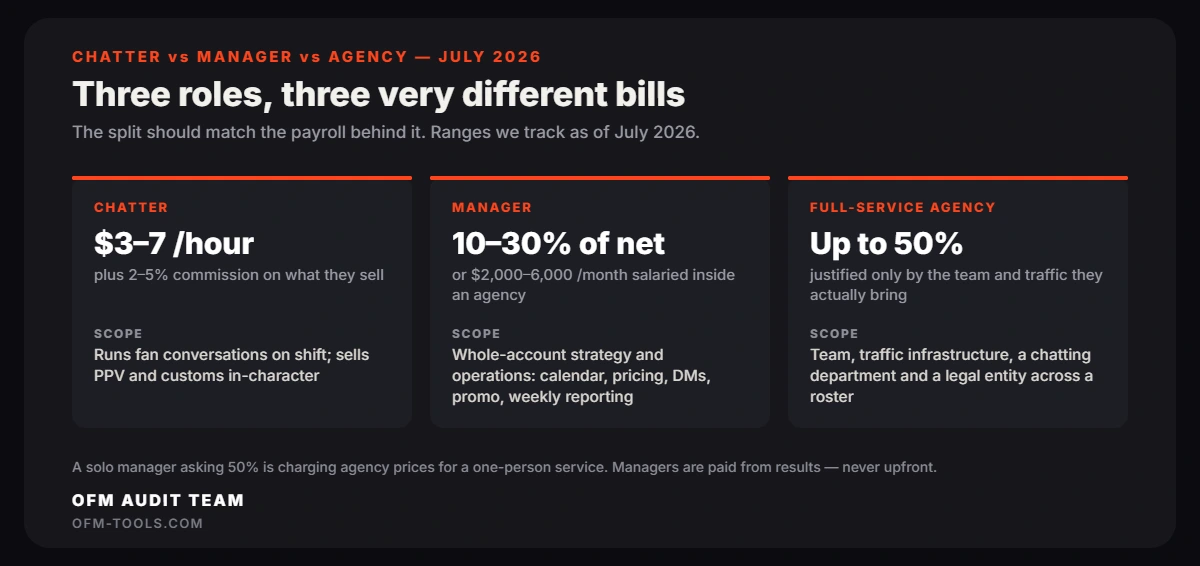
| Chatter | Runs fan conversations on shift; sells PPV and customs in-character | $3–7/hour base plus 2–5% commission |
| Manager | Whole-account strategy and operations: calendar, pricing, DMs, promo, reporting | 10–30% of net revenue independent; $2,000–6,000/month salaried inside an agency |
| Full-service agency | Team, traffic infrastructure, chatting department and legal entity across a roster | Splits up to 50% — justified only by the team and traffic they actually bring |
The rule of thumb: the split should match the payroll behind it. A solo manager asking 50% is charging agency prices for a one-person service; what a real agency delivers for that split is itemized in our management agency guide.
How OnlyFans managers get paid
Two structures cover almost everyone. Employed account managers inside agencies earn a base plus a bonus or percentage of managed revenue — $2,000–6,000/month in the ranges we track as of July 2026. Independent managers live on the revenue split: 10–30% of net, so managing one $20k/month creator at 20% pays $4,000/month.
One word in that sentence does most of the work: net. A split on net revenue is calculated after the platform’s 20% fee, refunds and chatter costs — a distinction that changes the manager’s check by 30% or more versus a gross split. Whichever side of the deal you are on, the contract has to define which one applies before any work starts.
How to vet a manager before you sign
For creators, five checks filter out most of the bad actors in one conversation:
- Written contract before any work. Split percentage, scope, exit terms and content ownership on paper. Our free OnlyFans agency contract template shows every clause a fair deal contains — use it as your checklist even if they bring their own paper.
- Net vs gross defined. If they cannot explain how the split is calculated, they have not done this before.
- Access without surrender. Professional teams work through CRM tools with team permissions, so nobody needs your password. You keep the email and the two-factor codes, always.
- Provable track record. Redacted dashboards, references from current creators — not screenshots of someone else’s earnings.
- A clean exit clause. What happens to the account, the fanbase and the content if you part ways is the clause you will care about most, and the one scammy contracts omit.
Want the job? The two ways in
Reading this from the other side of the table? There are two real routes into management. Route one: get hired — start as a chatter, get promoted to team lead, then account manager, earning a salary on agency infrastructure with zero startup risk. Route two: sign one creator independently on a written 15–20% split and build from there. The step-by-step version of both, with the salary tables, is in how to become an OnlyFans manager. And if your ambition is the whole business — entity, banking, team, roster — skip ahead to starting a management agency.
FAQ: OnlyFans managers
How much does an OnlyFans manager cost?
Independent managers typically take 10–30% of net revenue; full-service agencies charge up to 50% because they staff chatting, marketing and infrastructure. There should be no upfront fee in either model — managers are paid from results.
Is it worth getting an OnlyFans manager?
It becomes worth it when the DMs and promotion exceed what you can do alone — the manager’s split has to buy back more revenue than it costs. A creator with a small, manageable inbox usually gains more from better tools than from giving away 20%.
Is having an OnlyFans manager legal?
Yes — it is talent management for a legal platform. The requirements are the boring ones: a written contract, declared income on both sides, and every creator 18+ and identity-verified on the platform.
How much do OnlyFans managers make?
Employed account managers earn $2,000–6,000/month; independents take 10–30% of creator net revenue, and top independents running 3–4 accounts clear six figures annually. The full salary tables and the step-by-step path are in our become-a-manager guide.
Can a manager run my account without my password?
Yes, and that is the professional standard: agency CRM tools share access through team permissions, so chatters and managers work in the inbox without ever seeing credentials. Anyone who insists on holding your only login — or your email — is asking for leverage, not efficiency.